
Level Design: Map Design for a Strategy Game
The goal of this project was to design a balanced 1v1 map for a strategy game, encouraging a variety of tactical approaches and unit types. We have to work with classic gameplay mechanics — including units like archers and spearmen — and adapted them to fit our custom game world.
The design process focused on creating a layout that promotes strategic diversity while ensuring fairness and equal opportunities for both players.
Project developed in collaboration with Chaïnèze D'ALMEIDA
World Fantasy
Our game takes place during the Prohibition era in the United States, set in the 1920s–1930s. One of the key challenges of the project was adapting traditional strategy game archetypes — such as spearmen and archers — to fit this historical context.
We reimagined these units as characters inspired by the time period, while preserving their core tactical functions. To clearly distinguish the two factions, we assigned them specific colors: red for one team and black for the other. Each team also has a unique accessory — the black team wears classic hats, while the red team wears berets.
To further enhance the thematic immersion, we aimed to capture the sepia-toned atmosphere of vintage maps and photographs, using a color palette reminiscent of the era.


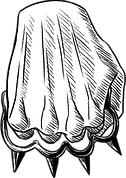

Basic units: Rifles are the equivalent of archers, cars are the equivalent of cavalry, breakers are the equivalent of spearmen and brass knuckles are the equivalent of soldiers.





Advanced units: Flamethrowers are the equivalent of balistes, mortars the equivalent of catapults, planes the equivalent of dragons and gang leaders the equivalent of leaders.

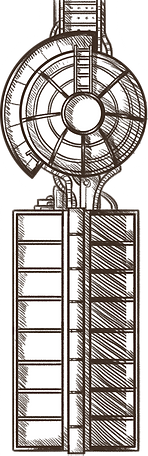


Settings: Barrels are the equivalent of barricades, distilleries are the equivalent of walls, protesters are the equivalent of forests and gravel heaps are the equivalent of hills.




Ressources: They are used to get units. Bullets are used to recruit rifles, petrol is used to recruit cars, banknotes are used to recruit all advanced units, and alcohol is used to recruit breakers and soldiers.
Map creation:
Once we had all our assets, we had to create the most balanced map possible.

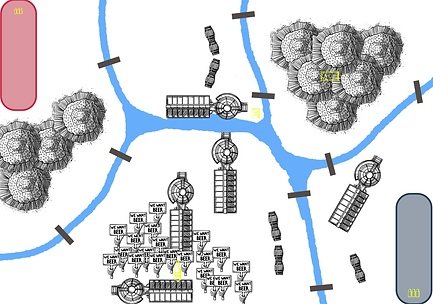

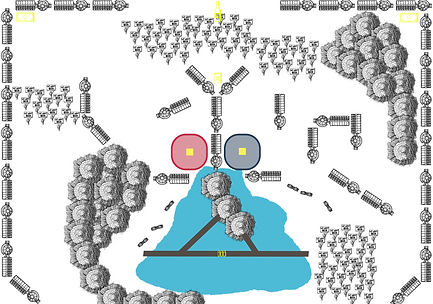
So we created several versions of the map, but we had a couple of problems. Firstly, the scale wasn't right, so we increased it on the 4th map. In addition, all the maps lacked identity and didn't represent the urban context we wanted. Finally, the maps were too complex without offering enough interesting situations for players to exploit.
Final Map:
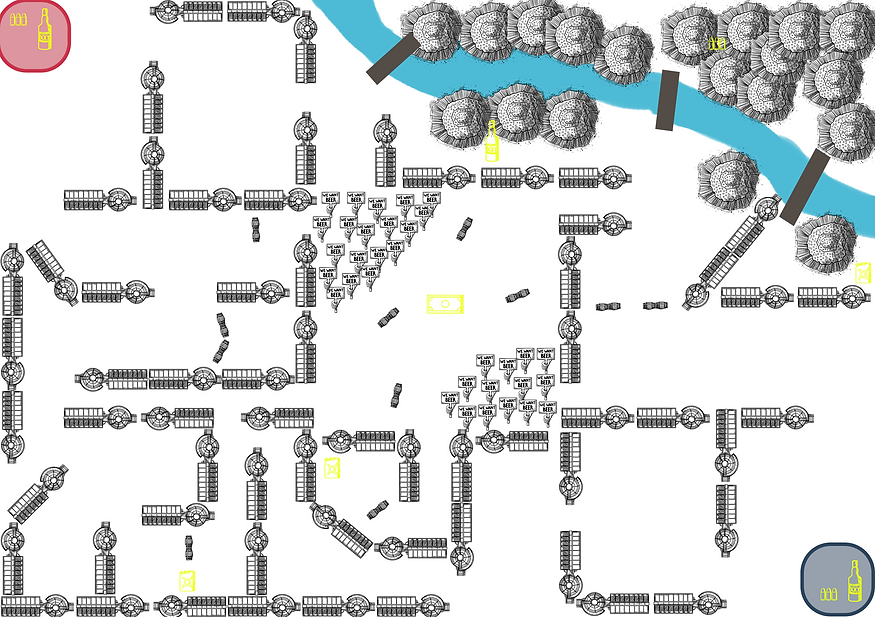
We've refocused on the narrative to create a coherent universe. In the south of the map, the walls are tighter, allowing for more hand-to-hand combat. In the center, we have a large square with a precious resource and lots of protesters for units to hide behind. In the north, we have an industrial wasteland with more space and more hilly terrain. This map is much more coherent than our previous iterations, and allows for different strategies. Units' strengths and weaknesses can be used and exploited to suit the map.
Final Map (visual):
We finished by reworking the visuals to give an overall aesthetic reminiscent of the aesthetics of the 20s and 30s. We also made the map more readable by clearly delineating the walls.

First detailled example:
In this example, we can see that the black player is outnumbered in the central square. The two breaker units face four opposing units. The red player expects to see the black player's army in the wasteland, so he positions his flame thrower and cars to protect the entrance through the wasteland. But the black player has a different strategy. He positioned his mortar above the central square to break through the wall and get to the back of the red breakers with his brass knuckles, which are just as strong against the breakers as they are supported by a gang leader. Here, the black player uses a bold strategy.


Second detailled example:
In this example, we can see that the black player has taken control of the resources, but the red player has done so on purpose. This enabled him to lock up the black player's units and thus catch him from behind. The black player thinks he can move forward, but he's trapped on all sides. His car is too far away, and the road is blocked by breakers that are strong against cars.

Third detailled example:
In this example, we can see that the black player has taken control of a dead-end street in order to obtain a valuable resource, while the red player waits patiently for him to emerge. To anticipate this, the black player hides his cars in the crowd of protesters. But in the end, the red player consumes fewer units in the zone and can therefore benefit from a surplus elsewhere.
